Communities don’t fail because people stop signing up. They fail when the people who do join the community stop asking questions. Or worse, ask a question and never get an answer.
Organizations with active online communities report up to a 21% boost in overall engagement- proof that when people are seen and heard, they stick around.
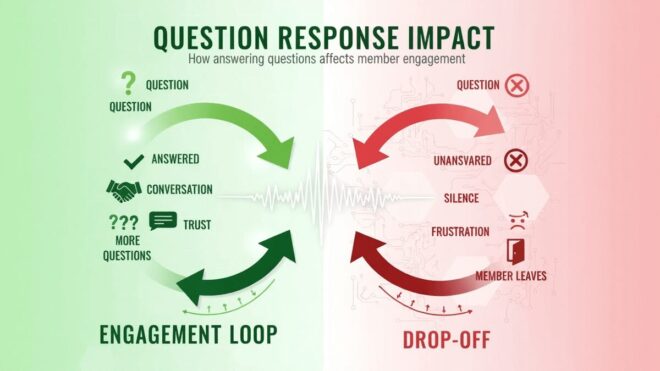
Nothing saps trust faster than silence. A member who feels ignored once is less likely to post again. Do it twice, and you’ve lost them.
Over time, unanswered questions stack up and send the quiet signal: “Nobody’s really here.”
The successful communities don’t just answer questions quickly; they create an environment where asking them feels natural, encouraged, and safe.
Because when members feel confident enough to share a challenge, they open the door to meaningful conversations, peer learning, and stronger bonds. And that’s the foundation of every thriving community.
In this post, we’ll explore why questions drive real engagement and how the new BuddyBoss Unanswered filter makes it easy to ensure no member query slips through.
Why Community Engagement Questions Matter
A statement can inform. A question invites transformation.
Think about the difference:
- Statement: “Module 3 is live.” Useful, but one-directional. Members consume and move on.
- Question: “What part of Module 3 slowed you down?” Suddenly, you’ve sparked reflection, peer sharing, and a chance to improve your course.
Statements deliver information. Questions create loops of collaboration, feedback, and action.
Here’s why:
- Questions show vulnerability. When someone asks, “How are you handling X?” they admit they don’t know everything. That humility creates room for connection.
- Questions invite collaboration. Every reply becomes a co-created solution. Members aren’t just consuming your wisdom; they’re helping each other.
- Questions build identity. The asker feels heard. The responder feels useful. And the lurker? They see proof that it’s safe to participate next time.
In other words, questions turn a static content hub into a living dialogue. They’re the seeds of trust.
BuddyBoss communities have an extra advantage here. With the new Unanswered filter in activity feeds, admins can make sure no question slips through.
A quick 5-minute scan highlights every post without replies, giving you a chance to jump in or tag someone who can help. That simple loop- member asks, someone answers; keeps engagement alive and growing.
Prompts That Inspire Members to Ask Their Own Questions
The best engagement doesn’t happen when admins keep tossing out icebreaker questions. It happens when members feel safe and inspired enough to ask their own questions. That shift from passive answering to active asking is where true community energy comes alive.
The trick is to use prompts that spark curiosity, vulnerability, and sharing. Instead of fishing for surface-level replies, good prompts nudge members to open up, invite feedback, and create threads others can naturally join.
Here are five powerful categories of prompts designed to spark curiosity, reflection, and peer-to-peer engagement. Use them as blueprints and adapt across your community niche.
Discussion & Debate
These prompts encourage members to share their perspectives, compare experiences, and challenge assumptions. The goal isn’t conflict- it’s to open space for diverse viewpoints that naturally lead to follow-up questions.
Examples:
- “What’s one tool you tried this year that didn’t live up to expectations?”
- “Which approach do you think works better for building trust- consistency or transparency?”
Show Your Work
Members feel more invested when they share progress, drafts, or behind-the-scenes details. These prompts invite vulnerability and make it easy for peers to jump in with clarifying questions or constructive suggestions.
Examples:
- “Post a screenshot of your current dashboard and ask- what’s the one thing you’re unsure about?”
- “Share a rough draft of your landing page- what’s one element you’d like feedback on first?”
Crowdsource Insights
The fastest way to build collective wisdom is by asking the group to pool their experiences. These prompts help surface patterns, best practices, and problem-solving strategies that others can adapt.
Examples:
- “What’s the biggest roadblock you’ve hit recently?”
- “If you could give one tip to someone just starting in this niche, what would it be?”
Lessons Learned
Encouraging reflection on past experiences helps members uncover valuable takeaways. These prompts turn setbacks into teaching moments and usually spark curiosity about how others handled similar situations.
Examples:
- “What was your toughest challenge last quarter?”
- “Looking back on your last project, what’s one thing you would do differently?”
Peer Feedback
Feedback is one of the most powerful engagement drivers—when framed as a question. These prompts turn critique into collaboration and create natural back-and-forth dialogue.
Examples:
- “Share your latest email subject line draft- what’s one word you’d test changing?”
- “Post your slide deck cover- what’s the first impression it gives you?”
Responses create a loop of back-and-forth questions, not just one-off comments.
Quick Prompts You Can Post Today
- “What’s one challenge you’re facing this week that you’d love feedback on?”
- “Share a screenshot of your latest project- what’s the one thing you’re not sure about?”
- “If you could ask one question to someone 2 years ahead of you in your journey, what would it be?”
A quick note of caution: Prompts should be used as sparks, not spam. Seeding a few thoughtful prompts each week is enough to inspire curiosity. Overloading members with daily admin-led questions can backfire, making the community feel scripted instead of organic.
Community Engagement Questions: More Examples Across Niches
To make this concrete, here are five more examples that inspire members to ask their own questions:
- SaaS founders: “Show your current dashboard. What’s the one question you’d ask before shipping it to users?”
- Course creators: “Which lesson are your students replaying the most? What’s the clarifying question you still haven’t nailed in your teaching?”
- Fitness coaches: “What tripped you up most this week- time, sleep, nutrition? Ask the group: How do you solve this?”
- Designers: “Drop your latest screen design. Ask peers: Is spacing or hierarchy breaking first?”
- Career communities: “Share your weekly learning plan. What’s the one technique question holding you back?”
Notice the pattern: Every prompt encourages someone to frame their own question and that creates organic conversation loops rather than one-off answers. You should start asking these community engagement questions to use today
Your Role as an Admin: Why Answering Matters
Questions are the lifeblood of engagement, but they only matter if they get answered. Nothing kills momentum faster than silence.
When a member asks a question and it hangs there without a reply, it sends an unspoken signal: “This place isn’t active.” The next time that member has a thought to share, they’re less likely to bother.
Multiply that across dozens of members, and you can see how quickly an active community slips into disengagement.
In fact, nearly 49% of community programs say faster response times are among their top engagement outcomes– showing just how much impact timely answers make.
The good news? Preventing this spiral doesn’t require endless hours. It’s about consistency, not volume.
The 10-Minute Rule
Set aside just 10 minutes a day to scan for fresh questions and respond. That daily rhythm does three important things:
- Shows you’re present. Members see the admin (or moderator) is active and paying attention.
- Builds trust. When someone gets an answer within hours- not days; it builds confidence that their contributions are valued.
- Invites peer replies. Your answers don’t need to be encyclopedic. Sometimes a quick nudge or tagging another member sparks a longer thread.
When admins model responsiveness, members follow suit. Your behavior sets the cultural tone: “In this community, questions get answered.”
Introducing the BuddyBoss Unanswered Filter
Even with the best intentions, questions can slip through the cracks. Members post at odd hours, threads move quickly, and new content can bury yesterday’s queries.
That’s where the new Unanswered filter in BuddyBoss comes in.
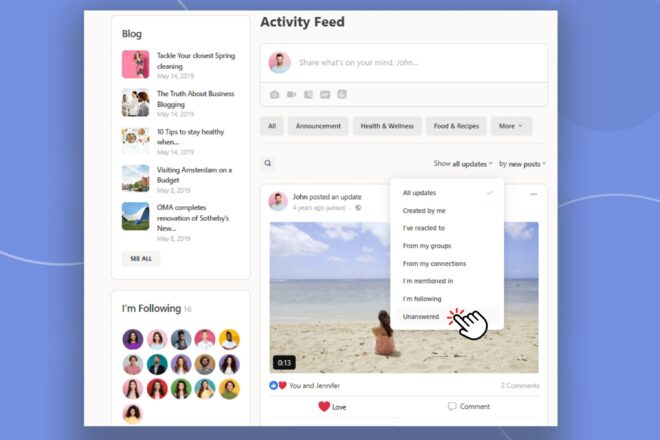
Think of it as your engagement safety net. With one click, you can instantly filter the activity feed (or any group feed) to see posts that haven’t received a single reply.
No more endless scrolling. The filter makes it easier to catch questions before they’re overlooked.
Why was it essential?
Without a system in place, unanswered questions pile up quietly.
- Members lose confidence
- Admins miss critical signals
- And what once looked like an active space starts to feel like an empty room.
How it works in practice
- Open the activity feed each morning
- From the activity feed dropdown (App Updates), select Unanswered option
- Scan for posts without replies
- Either respond directly, tag a knowledgeable member, or acknowledge the post to show it’s been seen
That tiny ritual 5 minutes with the filter helps you prevent questions from slipping through and keeps engagement flowing.
Feature Reality for Unanswered Filter
Native (Web + App): Available in BuddyBoss Activity Feed and Group Feeds.
What it does: Filters posts with no comments/replies.
What it doesn’t do: Doesn’t auto-answer. Human interaction required.
Best use: Daily 5–10 min scan to ensure no member is left hanging.
Practical Workflow for Driving Question-Based Engagement
Now let’s pull it all together into a repeatable daily routine:
Spark Curiosity with Prompts: Use discussion starters, feedback requests, or crowdsource-style questions to encourage members to ask their own follow-up questions.
Watch the Ripple Effect: As members begin to ask questions, the community starts generating its own conversation loops. Your role shifts from “content initiator” to “conversation facilitator.”
Check the Unanswered Filter Daily: This step is crucial. Spend 5–10 minutes reviewing unanswered posts. Jump in with a quick reply, or tag someone who can help. This keeps the cycle of engagement moving forward.
Encourage Peer-to-Peer Replies: Directly invite other members to chime in: “@Alex, you shared a similar challenge last week- what worked for you?”
Celebrate Answered Questions: Close the loop by acknowledging when questions get resolved. Gamification features like badges and points (available with BuddyBoss Gamification integration) can reinforce this.
FAQs on Community Engagement Questions
Q1. Do I need to be an expert on every question?
Not at all. Your role is to make sure questions don’t go ignored. A short acknowledgment or tagging another member is often enough.
Q2. What if my community is still small?
Small communities benefit even more. Members will forgive fewer features or less polish, but they won’t forgive silence. Answering quickly creates the perception of vibrancy.
Q3. How often should I check the Unanswered filter?
Once a day is plenty for most communities. For larger groups, check morning and evening.
Q4. Won’t constant admin replies make the community dependent on me?
Only if you dominate every thread. Use your answers to pull in other voices. Over time, members will answer each other.
Q5. Does BuddyBoss automatically answer questions for me?
No. The Unanswered filter doesn’t replace human interaction. Unanswered filter makes it easier for admins to catch overlooked questions, though replies still require human interaction.
Q6. What kinds of questions should I encourage in my community?
Focus on open-ended, experience-based prompts that spark curiosity and peer sharing. For example: “What challenge slowed you down this week?” works better than “Do you like Module 3?”
Utilize BuddyBoss Unanswered filter to Keep Every Question Alive
Unanswered questions are silent engagement killers. But they don’t have to be.
Now you can easily ensure every voice in your community feels heard. By sparking the right kinds of prompts, encouraging members to ask their own questions, and using the BuddyBoss Unanswered filter as your safety net.
The formula is simple but powerful:
- Prompts create the spark
- Questions fuel the conversation
- Unanswered filter helps prevent posts from being overlooked
Do this consistently- even just 5-10 minutes a day and you’ll transform your community into a space where members don’t just show up… they stay, engage, and grow.
👉 Try the new Unanswered filter in BuddyBoss today and see how easy it is to keep your community conversations alive.
Sources:
- Source 1- Social Plus
- Source 2 – Higherlogic