Successful online communities don’t just capture attention, they capture minds. Members don’t simply participate; they become deeply and often unconsciously hooked through powerful cognitive mechanisms that shape their behavior over time.
Research shows that true community engagement doesn’t come from surface-level likes, badges, or quick replies.
Instead, it’s the deeper psychological commitment processes that transform casual visitors into loyal advocates.
The most addictive online communities tap into seven key cognitive triggers that align with fundamental human psychology.
When combined, these triggers create self-sustaining engagement loops. Members return more often, contribute more meaningfully, and actively promote the community.
For community builders, understanding these mechanisms provides an edge over platforms that rely solely on generic gamification.
1. Variable Reward Scheduling: Unpredictable Dopamine Hits
This trigger mirrors the variable reinforcement schedules used in casinos and gaming apps. Predictable rewards lose their charm quickly, but unpredictable recognition keeps engagement fresh and exciting.
In elite communities, this plays out as irregular acknowledgment of valuable contributions. Members never know which post will spark a meaningful discussion, receive expert feedback, or unlock access to exclusive resources. The uncertainty creates a subtle anticipation loop.
Research even suggests that emotionally charged debates enhance engagement because they offer a mix of validation, challenge, and learning, creating a multi-layered reward system.
A great example to understand this trigger is Reddit. Reddit thrives on unpredictability. A post that goes unnoticed today might explode with thousands of upvotes tomorrow, drawing the user back again and again. That sense of “maybe next time” mirrors the same reinforcement psychology found in slot machines, keeping members hooked on the possibility of a big win.
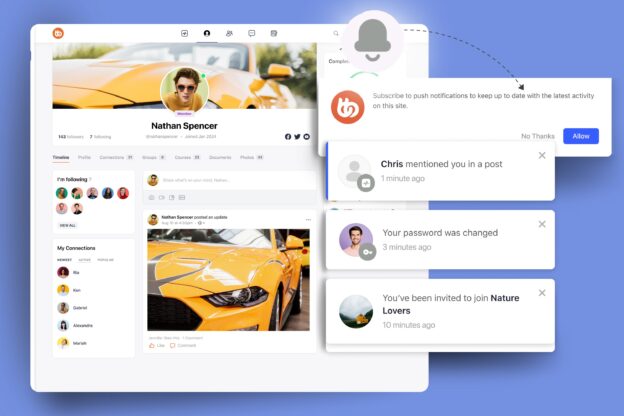
BuddyBoss Feature:- BuddyBoss has a comprehensive notification system you can configure on-screen, email, and app notifications. Admins also have the option to send manual or scheduled push notifications to targeted member segments.
2. Progressive Identity Integration: From Participant to Advocate
The most addictive communities become part of a member’s personal and professional identity. Over time, participation moves from “something I do” to “part of who I am.”
Members proudly label themselves as expert contributors or community moderators, integrating these roles into their LinkedIn profiles, bios, and personal narratives. Leaving would mean losing a piece of their identity, a cost most won’t pay.
On GitHub, developers often start by fixing small bugs, but over time, their contributions grow into major features or project leadership roles.
Their GitHub profile becomes part of their professional identity, a living portfolio that shapes how they present themselves to employers, collaborators, and peers.
BuddyBoss Feature:- The platform supports multiple custom profile types, editable profile fields, permissions, and segmentation (e.g., student vs. instructor) that shape member identity.
3. Social Proof Amplification: Peer Validation That Feels Real
Today’s audiences can spot fake likes and inflated follower counts from a mile away. Instead, addictive communities thrive on authentic, specific peer recognition.
Detailed appreciation calling out specific insights or problem-solving contributions does more than flatter; it models the behavior others want to replicate. Over time, this becomes a self-reinforcing loop of positive contribution.
Stack Overflow thrives on authentic peer validation. When someone’s answer is marked as “accepted” with a comment like, “This solved my issue after three days of searching,” it’s a powerful motivator.
Such targeted praise guides other members toward producing similarly valuable contributions.
BuddyBoss Feature:- BuddyBoss integrates with gamification tools like GamiPress and BadgeOS, allowing members to earn and display badges for various community actions.
4. Cognitive Investment: Solving Problems Together
People don’t just remember what they consume, they remember what they create. Communities that focus on collaborative problem-solving spark deeper mental investment.
When members co-create resources, brainstorm solutions, or collaborate on projects, they develop intellectual and emotional ownership.
This bond often extends beyond the original task, creating lasting professional and personal connections.
In the Figma Community, designers co-create templates, plugins, and UI kits. These collaborations foster both creative ownership and professional bonds. Even after a project ends, the relationships and pride in joint creations keep members coming back.
BuddyBoss feature:- Built-in social groups, group-specific activity feeds, forums, private messaging, and media sharing help facilitate collaborative problem-solving.
5. Environmental Mastery: Complexity That Rewards Growth
Communities that remain too simple risk losing advanced members; those that are too complex alienate newcomers. The sweet spot is progressive complexity gradually introducing more advanced features, challenges, and cultural nuances.
As members master these layers, they gain competence, autonomy, and status. The result? A steady progression that keeps both beginners and veterans engaged.
World of Warcraft keeps players engaged for years through progressive complexity. Beginners start with simple quests, but as they advance, they unlock sophisticated mechanics, group challenges, and elite content, creating a sense of mastery and accomplishment.
BuddyBoss Feature:- You can create tiered group types (public, private, hidden), gated access, and integrate with learning systems to enable progressive engagement.
6. Sunk Cost Escalation: Making Contributions Visible
The more members invest time, ideas, connections the harder it is for them to walk away. Communities that document and showcase contributions strengthen this effect.
When members can see their growth from asking questions to becoming a thought leader they value their participation history as part of their personal brand.
LinkedIn users accumulate years of posts, endorsements, recommendations, and connections. This visible career capital becomes too valuable to abandon, ensuring they keep returning if only to maintain their professional presence.
BuddyBoss feature:- Members have visible activity feeds, mention systems, directories, and media galleries all contributing to an ongoing personal history that’s hard to abandon.
7. Identity-Based Habit Formation: Engagement That Sticks
The ultimate stage of community addiction happens when participation becomes identity. At this point, engagement isn’t a task, it's an expression of self.
Members who see themselves as leaders, mentors, or creators remain active even without immediate rewards, because participation reinforces their self-concept.
Veteran Wikipedia editors don’t just “edit pages” they are Wikipedia editors. This role becomes part of their self-image, keeping them engaged even without direct personal gain.
BuddyBoss Feature:- BuddyBoss supports customizable member roles, group moderators, mentorship structures, and leadership designations that reinforce member identity.
Frequently Asked Questions
Which cognitive trigger keeps people coming back to communities?
Variable reward scheduling (like unpredictable notifications or post reactions) is one of the strongest triggers, as it creates curiosity and excitement.
Are these strategies only for large communities?
Not at all. Even small communities can benefit from cognitive triggers for engagement. For example, a small coaching group can use BuddyBoss roles and progress tracking to build identity-based loyalty.
Can BuddyBoss help reduce member churn with these triggers?
Absolutely. By combining features like progressive identity integration, activity history, and authentic peer recognition, BuddyBoss reduces drop-offs. Members stay because they’ve built social capital, professional identity, and habits tied to the community.
What’s the difference between gamification and cognitive triggers?
Gamification adds surface-level motivators like points and badges, while cognitive triggers go deeper into human psychology. For example, a badge is gamification, but receiving personalized recognition that reinforces identity is a cognitive trigger. Effective communities blend both.
Turning Psychology into Community Power
Building an addictive online community isn’t about manipulating members, it's about understanding what truly keeps humans connected, motivated, and inspired.
By applying these seven cognitive triggers you transform a passive audience into a self-sustaining, passionate ecosystem.
With BuddyBoss, you’re not just creating a platform, you're creating a place where members don’t just visit, they belong.
🚀 Ready to build a community people can’t quit? Start with BuddyBoss today.